

A professional jumpstart service process begins the moment you call for help and ends when your engine starts safely. Trained technicians arrive with the right equipment, assess your battery and electrical system, connect jumper cables in the correct sequence, and deliver the power needed to get you back on the road. The entire process typically takes 15 to 30 minutes from arrival to a running engine, depending on your vehicle’s condition and battery type.
Dead batteries happen without warning. You turn the key and hear only a click or a weak grinding sound. While some drivers attempt DIY jumpstarts with another vehicle, professional services eliminate the risk of electrical damage, incorrect connections, and safety hazards that come with improper technique.
Why a Dead Battery Demands Immediate Professional Attention
Modern vehicles contain sensitive electronics that control everything from fuel injection to steering systems. Connecting jumper cables incorrectly can send voltage surges through these systems, damaging control modules that cost hundreds or thousands to replace. Professional technicians understand the voltage requirements of different vehicle types, from standard 12-volt systems to hybrid and electric models with complex battery management.
Temperature extremes accelerate battery failure. Cold weather thickens engine oil and reduces battery capacity by up to 60 percent, while heat accelerates chemical breakdown inside battery cells. A battery that worked fine yesterday might fail completely today, leaving you in a parking lot, driveway, or roadside location.
The Initial Call and Dispatch in Seattle
When you contact roadside assistance, the dispatcher collects specific information to ensure the right equipment arrives. You provide your exact location using landmarks, GPS coordinates, or street addresses. The dispatcher asks about your vehicle make, model, and year because different vehicles require different approaches. Luxury cars, diesels, and hybrids need specialized knowledge.
The dispatcher also asks about recent warning signs: whether your lights dimmed before the battery died, if you heard clicking sounds, or if you smell sulfur near the battery. These details help technicians diagnose whether you need a simple jumpstart or a tow to a repair facility. Dispatch times in the Seattle area typically range from 20 to 45 minutes depending on traffic conditions and technician proximity.

Technician Arrival and Initial Vehicle Assessment
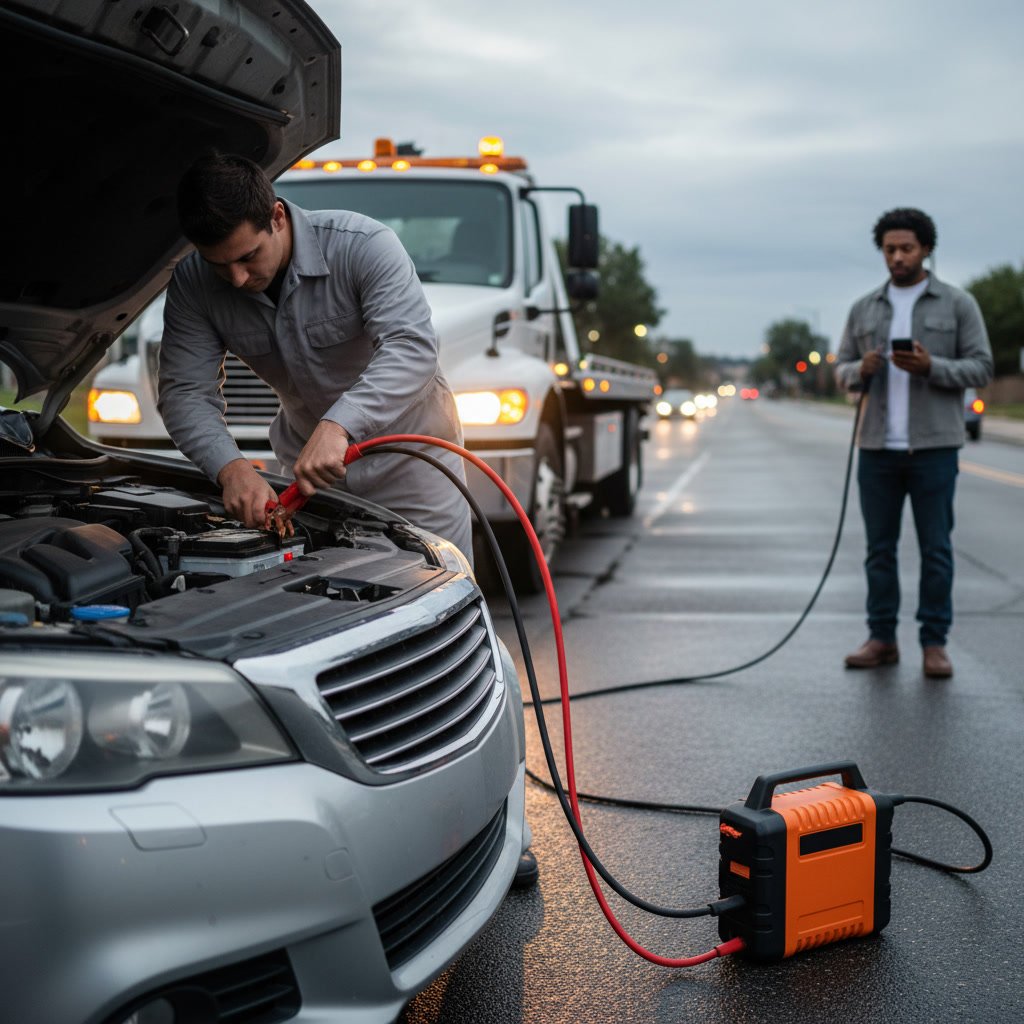
The technician arrives in a fully equipped service vehicle carrying commercial-grade jump boxes, jumper cables rated for heavy current flow, multimeters, and safety equipment. Before connecting anything, the technician performs a visual inspection of your battery and surrounding components. They check for corrosion on terminals, cracks in the battery case, bulging sides that indicate internal damage, and loose or damaged cables.
This inspection reveals whether a jumpstart will solve your problem or if you need battery replacement. A battery with a cracked case or severe corrosion might accept a charge but fail again within hours. Technicians also check your alternator belt for proper tension because a slipping belt prevents the alternator from recharging the battery after the jumpstart.
Safety Checks Before Connecting Any Cables
Safety protocols protect both the vehicle and the technician. The technician confirms that your ignition is off, all electrical accessories are turned off, and the vehicle is in park or neutral with the parking brake engaged. They check that both batteries are 12-volt systems and verify proper polarity before making connections.
Professional technicians wear safety glasses and insulated gloves. Battery acid is corrosive, and a short circuit can cause sparks or even small explosions if hydrogen gas has accumulated near the battery. The technician also ensures the jumpstart equipment is placed on stable ground away from moving traffic.
The Step by Step Connection Sequence
Cable connection follows a specific sequence to prevent electrical damage. The technician connects the positive (red) cable to the positive terminal of the dead battery first, then connects the other end of the positive cable to the positive terminal of the power source, whether that is a jump box or another vehicle’s battery.
Next comes the negative (black) cable. The technician connects one end to the negative terminal of the power source, but the other end does not go to the negative terminal of the dead battery. Instead, it connects to a clean, unpainted metal surface on the engine block or frame, away from the battery. This grounding point prevents sparks near the battery where hydrogen gas might ignite.
Professional jump boxes deliver a controlled charge that minimizes voltage spikes. These units contain built-in safety features that prevent reverse polarity connections and overcharging. The technician allows the dead battery to charge for several minutes before attempting to start the engine, giving the battery cells time to accept and store the incoming current.
The First Start Attempt and System Monitoring
After charging, the technician asks you to turn the ignition key or press the start button. If the engine cranks weakly, they allow more charging time. If the starter makes clicking sounds without cranking, the problem might be the starter motor rather than just the battery. A completely silent response suggests electrical connection issues or a severely depleted battery.
When the engine starts, the technician monitors the idle quality and listens for unusual sounds. They watch the dashboard for warning lights, particularly the battery or charging system light. If the battery light stays on after the engine starts, the alternator is not charging properly, and you will need professional repair rather than just driving away.
Post Start Electrical System Testing
After a successful start, professional technicians perform voltage testing that most DIY jumpstarts skip entirely. Using a multimeter, they measure the voltage at the battery terminals with the engine running. A healthy charging system produces 13.8 to 14.4 volts. Lower readings indicate alternator problems, while higher readings suggest a faulty voltage regulator that will damage your battery and electronics.
The technician also tests battery voltage with the engine off after disconnecting the jumper cables. A fully charged battery should read 12.6 volts or higher. Readings below 12.4 volts indicate the battery did not hold the charge well and might fail again soon. This testing provides valuable information about whether you can drive safely or need immediate battery replacement.
Safe Cable Removal and Final Recommendations
Cable removal happens in reverse order from installation. The technician removes the negative cable from the engine ground point first, then removes the negative cable from the power source. Next, they remove the positive cable from the power source and finally the positive cable from your battery. This sequence prevents accidental sparks and short circuits.
Based on test results, the technician provides specific recommendations. If your battery is more than four years old or showed low voltage retention, replacement is usually the best option. If the alternator tested poorly, continuing to drive risks another breakdown. The technician might suggest driving directly to a repair shop or, if the charging system is questionable, arranging a tow to prevent being stranded again.
You might also face a dead battery because you left lights on or have a parasitic drain from a faulty component. The technician can sometimes identify these issues during the service call, saving you from repeated jumpstarts. Similar diagnostic attention goes into other emergency services, as explained in detail about professional fuel delivery procedures.

What Sets Professional Service Apart From DIY Attempts
Professional jumpstart services carry commercial insurance that covers damage from service errors, something missing when a friend helps with jumper cables. Technicians receive training on the specific requirements of different vehicle types, including luxury brands, diesels with dual batteries, and hybrids with high-voltage systems that require special precautions.
Equipment quality makes a significant difference. Professional jump boxes deliver 1,000 to 2,000 peak amps, far exceeding the capacity of small consumer units. Heavy-duty cables handle high current without overheating. Proper cable gauge (typically 2 or 4 gauge for professional use) reduces voltage drop and delivers maximum power to the dead battery.
The documentation and follow-up also matter. Professional services provide written records of the service, including voltage test results and recommendations. This documentation helps you track battery health over time and provides evidence if warranty claims become necessary.
Getting Back on the Road With Confidence
Understanding how the jumpstart service process works helps you make informed decisions when battery failure strikes. Professional service eliminates guesswork, protects your vehicle’s electrical system, and provides diagnostic information that prevents future breakdowns. The small service fee is insignificant compared to the cost of replacing damaged electronics or being stranded in unsafe locations.
Whether your battery dies in a parking lot, at home, or on a roadside, knowing that trained technicians will handle the situation correctly reduces stress and gets you moving again safely. The process is systematic, tested, and designed to protect both you and your vehicle while solving the immediate problem efficiently.
Smith Towing provides professional jumpstart services throughout the greater Seattle area with trained technicians, commercial-grade equipment, and the expertise to handle any vehicle type. When your battery fails and you need reliable help, contact us at +18633732644 for fast response and professional service that gets you back on the road.